Category: Wichita and Kansas schools
-
Kansas school spending, or concern for students?
A Kansan’s letter to the editor in the Wall Street Journal is a good example of what is really wrong with Kansas’ schools — false and misleading information is used to prioritize institutional wants over student needs.
-
Kansas school spending, according to the Telegram
Another Kansas newspaper editorial shows that when writing about Kansas school spending, facts are sometimes not observed.
-
Kansas school test scores, the subgroups
To understand Kansas school test scores, look at subgroups.
-
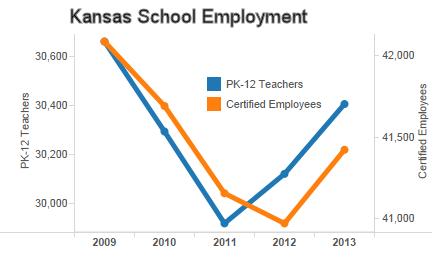
Kansas school employment: The claims compared to statistics
Claims made about Kansas schools don’t match the state’s statistics.
-
More about the New York Times on Kansas school finance
A recent op-ed in the New York Times contains six deliberate distortions of the truth about school finance in Kansas, writes Dave Trabert of Kansas Policy Institute.
-
Kansas school efficiency on display
When you hear that Kansas schools have “cut to the bone,” or are operating at maximum efficiency, or have nowhere else to cut, or there’s no need to audit school district efficiency, think of this.
-
New York Times on Kansas schools, again
The New York Times — again — intervenes in Kansas schools. As it did last October, the newspaper makes serious errors in its facts and recommendations.
-
Kansas education topic on ‘This Week in Kansas’
Kansas education issues were a topic on a recent segment of KAKE TV “This Week in Kansas.”
-
LOB property tax increase already in effect
Kansas school finance issues explained from Kansas Policy Institute.
-
Here’s why Kansans are misinformed about schools
Is the Kansas City Star editorial board uninformed, misinformed, or simply lying to its readers?
-
Kansas school test scores: What they don’t tell you
When comparing Kansas school test scores to those of other states, it’s important to consider disaggregated data.
-
Kansas school test scores, in perspective
When comparing Kansas school test scores to those of other states, it’s important to consider disaggregated data. Otherwise we may — figuratively speaking — let the forest obscure the trees.